lunes, 1 de abril de 2013

Como Mejorar Mejor!!!


Dos libros de Negociación infaltables

Enviado por Manuel Gross el 18/09/2009 a las 17:47
Manuel Gross

Pack de libros de Negociación infaltables

Por Carlos Melo

Ahora William Ury le enseña cómo superar los obstáculos en la negociación para triunfar. Aunque no siempre se dé cuenta, usted está negociando constantemente -cuando toma decisiones, soluciona problemas, cuando logra lo que desea.

Pero, ¿qué puede hacer cuando se enfrenta a una persona que no quiere negociar o es intransigente? ¿Cómo puede llegar a un acuerdo cuando la otra parte -un jefe colérico, un cliente irrazonable, un colega hostil, un socio engañoso, un cónyuge terco- no cede un milímetro?

En este indispensable libro, William Ury le enseña a usted a superar el NO. El método Ury de ?negociación de penetración? no se basa en ganar a sus oponentes, sino en ganarse a los oponentes; en hacer que entren en razón, y no en hacer que se pongan de rodillas.
Supere el No presenta técnicas prácticas para desactivar la pugna e inventar opciones creativas que satisfagan las necesidades de ambas partes. Usted aprenderá a reconocerle a su adversario su punto de vista sin ceder, y a exponer sus propios puntos de vista y sin irritar.

Por último, usted tenderá puentes de entendimiento en lugar de destruirlos. Resolverá las discrepancias y logrará llegar a acuerdos de manera amistosa, sin echar a perder unas relaciones valiosas.

- Descargar desde aqui

Metodo Harvard De Negociación

El libro ?Sí de acuerdo?? plantea el esquema de negociación del Equipo de Negociación de la Universidad de Harvard, en forma sencilla y práctica y con resultados ampliamente comprobados, como podrán evidenciarlo aquellas personas que se han sentado en una mesa de negociación.

Tal como sus autores lo manifiestan, lo aquí expresado no es novedoso y muchas personas seguramente ya lo conocían, sin embargo se presenta en forma sistemática y recoge los conocimientos derivados de las teorías, investigaciones y experiencias de estudios del tema.

Estrategias de negociación para que ambas partes queden satisfechas.

Estrategias directas y decididas para proteger los propios intereses y al mismo tiempo entenderse bien con las personas a quienes mueven intereses contrarios. Aunque se negocia todos los días, no es fácil hacerlo bien. Las estrategias estandarizadas para negociar dejan con frecuencia a las personas insatisfechas, cansadas o alienadas, o las tres cosas a la vez.

LA CONCIENCIA TOTAL Enric Corbera Parte 1º

sábado, 30 de marzo de 2013

Conferencia "Cambia tu Actitud, Cambia tu Vida - http://www.exitoalos40.com

La Inteligencia de La Rutina

 Esta Inteligencia de La Rutina
 Es fácil de detectar.
 Las personas hablan de tenacidad y de oficio o de saber hacer.
 Es fácil de reparar en una persona que tiene oficio.
 Muchas personas se dan cuenta y reconocen la tenacidad en los demás.
 Personas que tienen un reconocido saber hacer en su profesión.
 Esta Inteligencia la tienen todos los que aprenden con el paso del tiempo.
 No paramos de aprender y cada día aprendemos algo.

Las Distintas Inteligencias
 1.-Rutinas
 2.-Impulsos
 3.-Reflexión
 4.-Vocación
 5.-Actitud

La Inteligencia de las 10.000 Horas

Si quieres aprender algo has de practicar 10.000 horas es lo que dice en OUTLIERS Malcolm Gladwell.
Lo explica muy bien para el caso de Bill Gates y de los Beatles.
Es como aprenden los campeones del mundo de video juegos.
La Inteligencia de las Rutinas es la que se acumula en la practica ordenada de una actividad.
Malcolm Gladwell lo explica muy bien en FUERAS de SERIE o OUTLIERS.
Se aprende con esfuerzo y dedicación.
Gracias a esforzarte y dedicar horas con entusiasmo. Te haces en un experto. Y mejor si te ves arropado de grandes maestros.

También habla de crear Inteligencia Dan Colley que explica muy bien que la INTELIGENCIA se crea.

Es otro de esos libros que hay que leer.

Sí hay 4 tipos de Inteligencia de las que hoy quiero hablar
 1.-INTELIGENCIA de las RUTINAS
 2.-La Inteligencia de Los Impulsos
 3.-La Inteligencia REFLEXIVA
 4.-La Inteligencia de la vocación y de la Ilusión

La Importancia de las Rutinas: Es muy importante tener Rutinas


An invaluable survival strategy for parents and teachers of young children is the establishment of daily and weekly routines.
To help your child learn and remember the daily routines that occur between waking up and bedtime, you can use pictures that you cut out, draw, or take with a camera. For young children, concepts of time can be difficult, and pictorial representations help them understand the order in which things happens. This is also an effective way to teach ordinal numbers (first, second, third, and so on) as well as sequencing and time concepts.
As a mother of five children and an early childhood teacher for more than 30 years, I can tell you firsthand that when the routine was disrupted without warning, chaos followed! We adults like to know what is going to happen when we plan our day; if there are changes, we like to know in advance, so we can adapt our schedules. This is important for young children, too. As adults, we sometimes take for granted that our youngsters will adjust and go along with us. But that adjustment occurs much more smoothly when they are prepared for what is to happen during their day and they have some choices in their routine.
So when you know the family's routine is going to change, sharing that information with your child is always a good idea. Young children can be resilient when given a heads-up, or what I sometimes call an "advance organizer." As a teacher, I advised parents to tell their children what would happen through the day and to prepare them for changes, such as when they were to be picked up early, they had doctors' appointments, or someone else was going to come for them after school. As another example, weekends usually involve routines that are different than weekdays for families, so it helps to prepare children by telling them exactly what will be different.
It's also a good idea to let your child help you establish the family's routines. Giving your child the opportunity to make choices and decisions within the daily routine fosters responsibility and sharing. On laundry day, for example, asking your child to help sort colors from whites not only supports the development of responsibility and teaches your child that he or she can make valuable contributions to the family, but it also helps him or her to learn sorting and classifying skills, which are important in math, reading, and science.
My first four children were very close in age, but I had my fifth child eight years after my fourth. While my youngest was growing from toddler to kindergarten age, the older children were involved in tennis and tournaments, and their after-school activities dominated our lives. This meant that I had to prepare our youngest for after-school schedule changes that did not involve going straight home to cook dinner, so my routine included preparing sandwiches on those different days. My youngest child learned how to adapt to her four siblings' schedules, and my job was to make sure that, as she grew from a toddler to a kindergartener, she knew what was going to happen every day.
I also wanted to teach my youngest daughter, as well as her older siblings, that the activities we were involved in did not preclude us from learning. As we sat waiting for a tennis match, we always had the children's books that I had put in my bag, as well as small building blocks, crayons and paper, and small toys that allowed her to be creative wherever we were. Those times that she and I spent reading books, while the others were engaged in their activities and with their friends, strengthened our personal bond. Yet she was also still part of their lives and their friends' lives.
I found that wherever our daily routines take us, we can find opportunities for teaching and learning. For example, just talking with your child about what you see in the environment will help him or her to build oral language vocabulary, which is an important pre-reading skill. You can also strengthen important foundation math skills by grouping nearby rocks into sets of five, sorting leaves into different shapes or colors, grouping sticks into tens like tally marks, and whatever else you can imagine!
My youngest is now 20, and she and my other children say that those busy times were also some of the best times they have had. Like us, many families today have complex and very full schedules before, during, and after school. Established routines make for smoother transitions and help children to prepare mentally for the day and what is to come, while providing frameworks in which creative learning can occur.
So whether you are learning a routine, or creating a routine for learning, think of it as an opportunity for spending quality time with your children -- and you will also be creating wonderful memories of early childhood. 

Learning Through Routines


Learning Through Routines

Key links to Early Years Learning Framework (EYLF)- EYLF Principle 1. Secure, Respectful and Reciprocal Relationships- EYLF Principle 2. Partnerships- EYLF Practice 1. Holistic Approaches- EYLF Practice 2. Learning through Play- EYLF Practice 3. Intentional Teaching- EYLF Practice 5. Learning Environments- EYLF Practice 7. Continuity of Learning & Transitions- Linked to all five EYLF learning outcomes 


What is a routine?

“A routine can be thought of as any procedure, process, or pattern of action that is used repeatedly to manage and facilitate the accomplishment of specific goals or tasks” - (Visible Thinking, n.d)

Importance of Routines

Uncertainty and change is innately stressful for all human beings (Cooperative Extension Service, 1989).  Routines are important to everybody, but they are especially for young children as it allows children to navigate the continuous challenge of learning new things from the safe and comforting boundaries that are created by routines.  Gan Discovery (2002) outlines the importance of routines/patterns as emotional regulators to decrease stress, anxiety and conflict.  Gil (2010) extends on this further  and outlines how routines help integrate learning with an ‘organized connection’.  
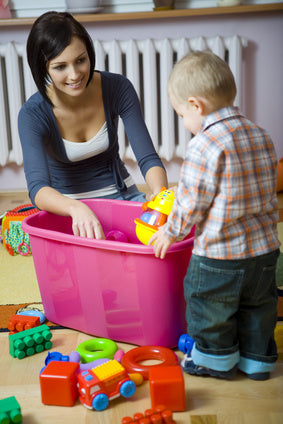
Educator guiding toddler through clean up routine
Routines are important because they give children a sense of security and control over their environment. Children learn what to expect at various times in the day and as they begin to participate in these routines, they will experience a sense of control and satisfaction at being able to perform part of or all of the tasks associated with the routine.
Routines are also effective in managing negative behaviour particularly when it comes to dealing with transitions into new tasks. Routines allow children to emotionally prepare for changes that are to come.  For example, a child will know that certain things happen as he gets ready for bed and as he progresses through the routine, he will also know what is expected of him when the task is completed.
Some of the important skills children learn through routines include: self control, positive behaviour and social skills. Routines can even help strengthen the relationship between you and your child as power struggles are significantly reduced (Zero to Three, n.d.).
Learning Through Routines
Routines provide a two pronged approach to fostering learning:
1.       they provide learning within the routine itself and the specific tasks associated with the routine;
2.       through the process of generalization (i.e., establishing a frame of reference that can be used to learn other skills and concepts (Gil, 2010).
Routines provide a context for learning to take place. Routines help children learn how their world is organized and what they need to do in order to interact successfully in that world (Sussmen, 2011). For example, after they wake up they need to get dressed and have breakfast before getting ready to go to daycare. At daycare, they need to hang up their jacket, say good morning to the teacher and then they will have time for some free play for a while before they may later sit down together as a group. Routines will give each child a sense of continuity throughout the day as well as letting them know what to expect next.  Within routines children also learn methods associated with math and sequencing: used to follow an ordered sequence of activities, determine relationships between elements, count, and make simple calculations
Routines not only help children learn about their day, they can also help develop motor skills as they begin to practice the tasks involved with the routine. A child’s confidence level will also begin to increase as they become more and more successful at performing those tasks. Children may initially not be able to get dressed by themselves but they will slowly develop the skills necessary and will soon be able to accomplish the task on their own.
Getting parents involved not only in passing on key routines from home, but also sharing in key routines for your early childhood service, will strengthen the security and comfort children take from routines. 
Routines can also provide opportunities for little children to slowly increase their responsibility and care of self and it is important that families and educators work patiently together to strengthen children’s confidence to do this.
Social skills can also be taught through routines such as welcoming, saying goodbye, turn taking and group times.  Gill (2010) refer to this as ‘tactile and/ or visual modeling’: used when learning a new action in the routine or repeating an action that has not yet been mastered.    By teaching children what behaviours are appropriate and at what times, it can teach them how to start conversations and interact with other people (Sussmen, 2011).  Routines can give educators and parents a chance to practice conversations with their child as well as providing an opportunity for the child to initiate conversation. Children can inform educators and parents when it’s time for a routine to take place as well as what comes next in the routine.
Routines also teach children specific skills involved in the routine as well as skills that can be used in other circumstances (Rodriguez-Gil, 2010).  For example, a routine that is learned in a pre-school will be brought home and practiced there. If the expectation at the pre-school is that children arrive and immediately put their school bag away, this routine can be imported into the family home so that children will put their school bag away when they get home as well.
Routines can also have a powerful effect on language learning because of all the opportunities they provide excellent prompts for discussion. As educators and parents progress through the various daily routines, they can name the items that are being used in the routine, they can discuss each action as it is being done and they can discuss what comes next. Their child will begin to understand the vocabulary that is associated with the routine. Gill (2010) refers to this as ‘adapted communication’: used by the child and the communication partner as needed in the routine to anticipate, to name, to make choices and to have a conversation about actions, people, objects, places, physical sensations and emotions.
Making Routines effective
In order for routines to be a practical source for learning you need to make sure that you have enough time to take each task within the routine slowly and you need to be sure that you discuss each individual task with your child (Linden, 2000). You need to try and do the same thing the same way each time you do a routine and you should also try to use the same language to help reinforce language learning.  Take time out to write your routines down and discuss them which your colleagues, children and their families (Linden 2000).
You shouldn’t think of routines as tasks that need to be performed but instead as opportunities to interact in a meaningful way with your child. By talking, touching and interacting in other ways with your child, you can actually use daily routines to help develop and strengthen the bond with your child as well as providing the opportunity to learn a number of different skills.
Think of ways you can continue or leverage learning from a routine.  Here are some examples:
-          implement written literacy elements into a routine, by including words to label/describe routines, children can use the predictive understanding of their routines to learn new words;
-          use routine and maintenance times as opportunities to explore conversation and interaction with children such as during nappy change and meal times.
-          discuss routines with children and ask them how their routines could be changed, extended or improved;
-          look for opportunities to extend or challenge children in the routine, such as ways to take on more responsibility or complete more difficult tasks. 
-          Look for new routine opportunities which children and educators can use on a daily basis to explore, discuss question and investigate (Here is a link to some amazing classroom ideas for doing thishttp://pzweb.harvard.edu/vt/VisibleThinking_html_files/03_ThinkingRoutines/03d_UnderstandingRoutines/Headlines/Headlines_PoP.html.
Authors: Natalie Higgins and David Gregory

About Raise Learning

This article has been written by Raise Learning,  providers of LIFT (Learning Involving Families & Teachers - an online programming and documentation tool) and other early childhood management tools.  If you would like to know more about Raise Learning or LIFT please visit our home page.   


References:
Cooperative Extension Service (1989)  Michigan State University ”Stress and Change” Extension bulletin E-2201, Home Economics Program retrieved 19/03/2012 fromhttp://www.baycounty-mi.gov/Docs/CitizenCorps/StressAndChange.pdf
Gan Discovery (2002) “Child Care Routines - The Value and Importance” retrived 19/03/2012 from http://www.gandiscovery.com/Child_Care_Routines.html
Linden, J., 200, Good Habits – Learning Through Routines, viewed March 14, 2012, http://www.nurseryworld.co.uk/news/722529/Good-habits---learning-routines/
Rodriguez-Gil, G., 2010. Routine-Based Learning, reSources, vol. 15 no. 2, viewed March 14, 2012,   http://files.cadbs.org/200001020-a077da171a/RoutineBased.pdf
Sussmen, F., 2011, The Power of Using Everyday Routines to Promote Young Children's Language and Social Skills. The Hanen Centre, viewed March 14, 2012,http://www.hanen.org/Helpful-Info/Articles/Power-of-Using-Everyday-Routines.aspx
Visible Thinking (no date) "Thinking Routines" retrieved 19 March 2012 from  http://pzweb.harvard.edu/vt/VisibleThinking_html_files/03_ThinkingRoutines/03a_ThinkingRoutines.html
Zero to Three, n.d., Love, Learning and Routines, viewed March 14, 2012, http://main.zerotothree.org/site/PageServer?pagename=ter_key_social_routines&AddInterest=1157